Returns from goat farming
By Dr Ali Moh Khushk & Moh Ibrahim Lashari
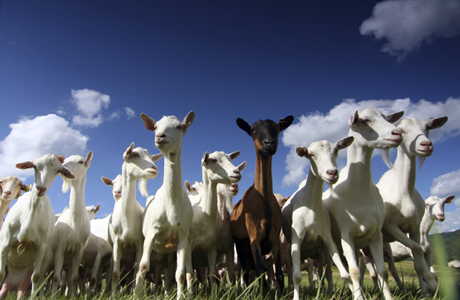 Goat
and Sheep farming has a great scope in Sindh due to climatic
conditions , canal network, forest areas, pastures within
valleys, grass along canal and road sides, and efficient
labour force.
Goat
and Sheep farming has a great scope in Sindh due to climatic
conditions , canal network, forest areas, pastures within
valleys, grass along canal and road sides, and efficient
labour force.
The rearing of small
animals has greater advantages over other livestock.
This business not only
supplements the farmer’s income but also compliments crop
production by providing means of subsistence and employment
in rural area.
The province is home to
many important sheep and goat breeds.Small ruminants for
various reasons play an important role in agriculture since
they do not require costly inputs.
Their meat, milk and the
converted dairy products are valuable goods. The products of
small ruminant such as wool and skin are of secondary
importance. Small ruminant farming is an integral part of
agricultural production system.
These provide protein,
particularly to those living in rural areas.
Goat and sheep flocks are maintained through traditional
production system. Their feeding requirement is met through
grazing. Their main management is climate, vegetation,
resources, disease control and feed supplement.
In a study, it was found that the majority 59 per cent
animals are fed from fields, 20 per cent use stall feeding
and 21 per cent grazing as well as stall feeding.
About 51 per cent feeding is
dependent on tree leaves, cut fodder and kitchen waste - 29
per cent on tree leaves and 20 per cent on cut fodder.
The major portion of milk is consumed by kids/lambs and the
remaining quantity by the family. A very small quantity of
milk is marketed after mixing it with cow and buffalo milk.
The sheep producer
use traditional method of shearing i.e., cut by
simple scissor. A majority of the 92 per cent
respondents said that they shear their animal twice
a year while eight per cent did it once.
About 56 per cent sell wool
on per sheep basis while 44 per cent on per kg base. On an
average, sheep wool is sold for Rs8 per kg and Rs10 per
animal.
Multiple birth rates indicate that 60 per cent of sheep give
single birth while remaining of 40 per cent twin births.
Same 60 per cent goat give twin births while 29 per cent
single, whereas 11 per cent goat give birth to triplets.
Small ruminants are affected by bacterial disease with seven
per cent reporting viral disease and six per cent, both
bacterial and viral diseases in the study area. About 67 per
cent get their animals vaccinated while 33 per cent are
unaware of it.
Almost every household uses family labour for milking.
Similarly, for manure gathering 38 per cent use family male
labour and 14 per cent hire male, whereas 40 per cent use
family female and eight per cent children.
Marketing comprises movement of livestock and their products
(food and raw material) from the farm to final consumer. In
case of products, the marketing continued through processing
which changes the nature and form or use of the product. It
includes processing, grading and packing.
The livestock markets are locally called ‘Mall Piri’ held
weekly in nearby towns where buyers and sellers strike
deals. Such markets are held daily in big cities located in
consumption areas.
These offer good business for
brokers and agents of big traders and marginal traders.
Producers often hesitate to sell their animals in these
markets because of the exploitation by agents,
transportation problem, huge expenses involved in the form
of marketing charges and feeding and the time consumed
during visits.
There are no standards to weigh livestock and their
carcasses. The deal is struck through estimation which
becomes the basis of price offered by a buyer.
The brokers and agents are
clever in bargaining while guessing the helplessness of a
seller. Almost all livestock producers are simple and
illiterate people.
A primary market is a patch of ground near a village where
livestock from same or surrounding villages is brought for
sale. These are also designated as local or producer market.
Secondary markets are located in towns to which livestock
traded at village markets is brought for sale. These markets
are also called transit markets. Local town committees
control these markets.
Tertiary markets are located in large cities where animals
are usually brought from secondary or primary markets. These
are also designated as regional markets. Import and export
of livestock occurs internationally from one country to the
other from the national markets.
The purchaser directly
contacts the seller and negotiates the price without the
help of intermediary, while at other times a broker serves
as a catalyst for settlement of prices.
In Sindh, sheep and goat wealth is in the hands of poor
people. Goat farming is carried out as a way of life instead
at commercial scale. The goat farming units are not operated
efficiently due to poor knowledge of modern practices. The
system needs improvement.
Courtesy: Dawn News