E-Dusting/Web removal
Once litter has been removed the next priority should be
removal of numerous spider web that bloom here and there on
walls, flying birds often enter in the sheds and build nests
in ceiling, these should be removed.
F-Repairing
During this period done all the
repairing work like repairing work of gas pipes, brooders,
electricall equipments, windows and doors.
Wash House
Wash ceiling walls floor with generous amounts of water.
Preferably add some detergent to wash house. Next all cracks
crevices in the wall floor or ceiling should be filled up.
All leakage in the gas pipes or water pipes should be
sealed, electric short circuit should be corrected and fuse
etc should be replaced.
G-Disinfection
A basic essential is that disinfection programme must be
most carefully planned. The disinfection of a building
implies the elimination from the house all microorganism
that are capable of causing disease. Follow the manufacture
instruction carefully and make sure that the disinfection
has proven active against the pathogens.
H-Fumigation
This is the very important procedure to give a final boost
to the disinfection programme, at this stage the house is
setup ready for the next crop for this purpose formaldehyde
gas is most suitable.
The shed should be properly sealed
before fumigation 17.5 gram Kmno4 and 35 CC formaline can be
used for fumigation.
I-Provision of material
i) Litter
Put the litter in the selected area, there
should be ample supply of relevant material e.g rice husk,
saw dust litter should be economical, comfortable and
absorbent, saw dust may be from hard wood or soft wood while
using for chicks soft wood saw dust should be used because
hard wood contains tannin which will be eaten by chicks and
result in high mortality due to vent pasting .Try to cover
saw dust by newspaper or paper so that chicks cannot eat it
in the beginning.
ii) Feed
For starter you may use ground maize, which
is easily digestible and due to its high fiber content
reduce pasting problem. It is a good source of energy.
iii) Fuel
In case you are using kerosene oil, wood or coal burning
brooders, you should have stocks of relevant fuel.
iv) Equipment testing
Never forget the functional capability of your brooders. The
burners should be controlled properly. The gas or electric
supply should be proper.
ARRIVAL OF CHICKS
Following precautionary measures may be undertaken at the
arrival of chicks.
i) The chicks should be arrive early in the
morning so that you have full day to observe them and take
care of them.
ii)
Place the chick guard (2-3 feet from the edge and increase
area weekly this will reduce cannabalism and increase feed
utilization.
iii) Do
flushing at start for this use 250gm sugar/gallon of water,
which is mixed to provide carbohydrate to chick and clear
the digestive tract.
iv) Use
ground maize for 2-3 days for feeding because it contains
more fibers, which is easily digestible.
v) Use
certain broad-spectrum antibiotics for 5 to 7 days. If
chicks are healthy, then use for 3 days and if there is
infection then give about for 7 days to reduce the
outbreak.e.g:
·
Tribrisin 1 c c/gallon of water.
·
Erythro
F.Z 4 tea spoon/gallon of water.
·
Oxytetracycline 11% 125 gm/gallon of water.
vi)
Brooder temperature should be kept at 90-95F each week and
don’t go less than 75F.This temperature should be recorded
at the height of about two inches above the litter on the
outer edge.
vii)
Farm manager should be present and ever alert, count the
number of the chicks, closely regulates temperature of shed
and of the brooder and above all observes closely, all
requirements of birds.


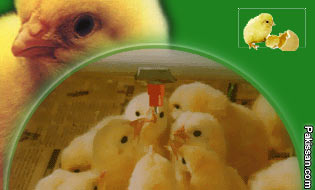 All the managemental practices before
brooding or before receiving the chicks in other sense
various measures, which we provide in preparation for
new-hatched chicks arriving at our farm.
All the managemental practices before
brooding or before receiving the chicks in other sense
various measures, which we provide in preparation for
new-hatched chicks arriving at our farm.