A BRIEF ON FISHERIES ON PAKISTAN
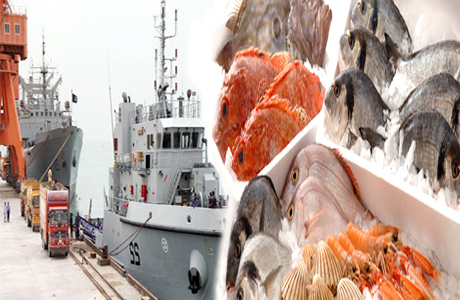 Fishery
plays an important role in the national economy.
Fishery
plays an important role in the national economy.
It provides employment to
about 300,000 fishermen directly.
In addition, another
400,000 people are employed in ancillary industries.
It is also a major source
of export earning.
In July-May 2002-03 fish
and fishery products valued at US $ 117 million were
exported from Pakistan.
Federal Government is
responsible for fishery of Exclusive Economic Zone of
Pakistan.
In addition, It is also
responsible for making policies, inter-provincial
co-ordination, planning, research, quality control,
training, exploratory fishing, stock assessment, fisheries
management, fleet improvement, data collection and export
etc.
Pakistan is endowed with rich
fishery potential. It is located in the northern part of the
Arabian Sea and has a coastline of about 1,120 km with a
broad continental shelf and its Exclusive Economic Zone
extends upto 200 n. miles from the coast.
There are about 16,000
fishing boats in coastal area of Pakistan which operate in
shallow coastal waters as well as in offshore areas.
These fishing boats undertake
fishing trips lasting for few hours to about 25 days
depending upon type of fishing. Total production from inland
and marine waters is approximately 0.60 M. tons.
FISH HARBOURS OF
PAKISTAN
The major fish harbours of Pakistan are:
Karachi Fisheries Harbour is being operated by
Provincial Government of Sindh.
Karachi Fish Harbour handles about 90% of fish and
seafood catch in Pakistan and 95% of fish and
seafood exports from Pakistan.
Korangi Fish Harbour is being managed by Federal
Ministry of Food, Agriculture and Livestock.
Pasni Fish Harbour being operated by Provincial
Government of Balochistan.
Gwadar Fish Harbour being operated by Federal
Ministry of Communication.
FISH PROCESSING PLANTS.
There are 29 fish processing units in Pakistan with
storage capacity of 10,000 tons, out of these 25
units are locate in Karachi of Federal Government
provided intelligentsia and technical assistance to
seafood establishments for improving their
processing conditions in line with various EU /
international standards. Through this process, 8
establishments have already improved their
conditions and were approve to export seafood to
European Union countries. In addition, another five
plants have almost upgraded their conditions and
others are also undertaking changes in their
facilities to comply with EU / international
standards.
FISH CONSUMPTION/UTILIZATION.
A substantial quantity of fish is consumed locally.
In addition, small pelagics and by-catch of trawl
fishing is being used for production of fish meal.
Remaining balance is exported in salted dried,
frozen and chilled form. The data for consumption of
fish is annexed.
FISH EXPORT.
Fish and fishery products are processed and
exported to over 50 countries. About 30 – 35% of the
fish and fishery products are exported to European
Union countries. Japan, U. S. A. China, Saudi
Arabia, U. A. E. Malaysia, S. Korea, Hong Kong, Sri
Lanka and Singapore are other major importing
countries. The export data is annexed.
Fish export has showed an increasing trend in the
past many years, however, a substantial decrease has
occurred during 1998-99 which is attributed mainly
due to glut in the international market and because
of financial crises in the Southeast Asian
countries. Export of seafood is facing many a
problem notably among these are:
Post harvest losses are high due to handling of fish
catch on board and long voyage time.
Congestion at Karachi Fish Harbour. There are more
than 16,000 fish boats operating in Sindh zone.
The storage capacity is only 10,000 tons which is
not sufficient to cater the future requirements.
Pakistan is exporter of raw material or semi
processed fish / seafood.
Marine aquaculture is non-existent, however, fresh
water aquaculture is fairly developed.
The Government of Pakistan is taking various
measures to increase the export of seafood over US$
500 million within next two years. The measures are:
Up-gradation of fishing vessels to control post
harvest losses.
Provision of modern peeling sheds for providing raw
material to fish processing industry.
Flake ice plants on harbours.
Intensive marketing efforts at international level.
Promotion of marine aquaculture.
Human resource development through training.
Regular monitoring of resources through stock
assessment surveys and exploratory fishing.
Procurement of handling and cleaning equipments for
fish harbours.
Construction of coastal highway.
LEGISLATION
In order to comply with EC Regulations and to
control the quality of seafood, Government of
Pakistan promulgated Pakistan Fish Inspection and
Quality Control Act, 1997 and Rules, 1998 thereunder.
EPB’S ROLE IN FISHERIES
EPB has been the main coordinating agency in
improving the hygienic conditions in Karachi Fish
Harbour and up-gradation of fish processing units to
meet European Union and international standards.
Ministry of Commerce / Export Promotion Bureau
provided assistance to all agencies concerned with
export of fish / seafood from Pakistan. Th following
assistance / funds were provided by EPB to Karachi
Fish Harbour to meet the European Union requirements
regarding hygienic conditions at the harbour:
EPB imported 10000 fish crates at the cost of Rs.
7.0 million and which are being used in auction
halls, fishing trawlers and processing units. EPB is
also importing 200,000 fish boxes to meet the
requirement at Karachi Fish Harbour.
EPB provided an amount of Rs. 5.0 million to Marine
Fisheries Department, Karachi for procurement of
appliances and equipments for up-gradation of
Quality Control Laboratory to meet European Union
requirement.
EPB procured 200 fibre glass trolleys for handling
of fish / shrimps at Karachi Fish Harbour for an
amount of Rs. 3.7 million.
EPB provide Rs. 1.0million for up-gradation of
auction halls in Karachi Fish Harbour.
EPB procured hot water pressure washing machine for
cleaning of boxes and auction halls and foot
operated taps at a cost of Rs. 0.386 million for
Karachi Fish Harbour.
Besides EPB played a very vital role alongwith
Marine Fisheries Department in upgradation and
approval of 7fish processing units by the EU
Inspection Mission during the month of March’ 999
Courtesy: Pakissan Report